Solvit — Valuation Management Platform
Designed a two-sided web platform — a company portal for requesting valuations and an admin backend for running the entire business, from onboarding to invoicing.
2
Platform Sides
8
Admin Modules
Designer + PM
Role
Ongoing
Engagement
Overview
Solvit connects professional valuers (solvers) with insurers, banks, lenders, and fleet managers who need asset valuations. The web platform has two sides: a company portal where clients initiate and track valuation requests, and an admin portal where Solvit staff run the business.
I designed both sides. I now manage client delivery and engineering execution to ship what I designed.
Admin Portal Scope
- Onboarding new companies and solvers
- Assigning jobs, tracking the request lifecycle
- Reviewing completed valuations for quality
- Generating and managing invoices
The Problem
Company Side
- Valuation requests were submitted by email and phone — no structured intake
- No visibility into where a request stood once submitted
- Reports delivered by email with no central record
Admin Side
- No purpose-built system — operations stitched across email, spreadsheets, and phone calls
- Onboarding new companies and solvers was manual and inconsistent
- Assigning the right solver to the right job required manual coordination with no tooling
- Invoice generation and billing tracked in separate spreadsheets
- This couldn't scale
Company Portal
Request Creation
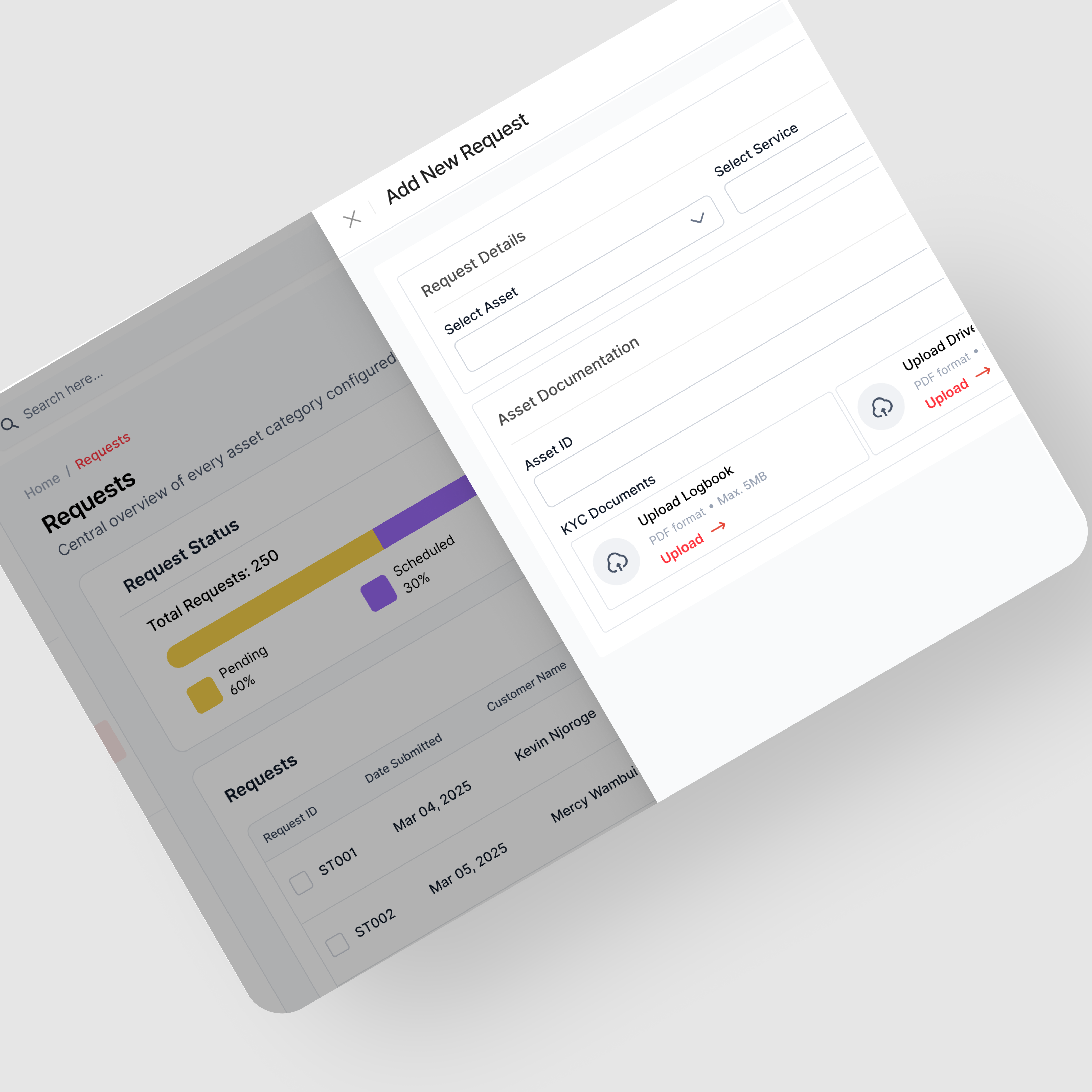
A guided flow for initiating a valuation, inspection, or assessment job across multiple asset types. Clients provide asset details, location, urgency, and any supporting documents — structured intake that replaces an email chain.
Request Tracking
Real-time status visibility from submission through assignment, in-progress, and completion. No more 'where's my report?' calls to the office.
Report Delivery
Completed valuation reports delivered directly in the portal for review and download. The full lifecycle — submit, track, receive — in one place.
Admin Portal
Company & Solver Onboarding
Registration, verification, and approval workflows for new client companies and solvers joining the platform. Credential verification and skills/location profiling for valuers baked into onboarding.
Request Assignment
Matching incoming requests to available solvers based on asset type, location, and expertise. Manual assignment with smart suggestions — the admin has control, the system does the legwork.
Request Lifecycle Management
Full pipeline view: new → assigned → in progress → completed → invoiced. Every request tracked from intake to close. No request falls through the cracks.
Valuation Review
Completed work reviewed and approved before reports go to the client. Quality control built into the workflow — not an afterthought.
Invoice Generation & Billing
Create and send invoices tied to completed requests. Billing history and payment tracking per company. Finance operations visible in the same system as everything else.
Reporting & Analytics
Operational dashboards: request volumes, turnaround times, solver utilisation, revenue, and billing health. The numbers the business needs to run, in one place.
User & Role Management
Admin, staff, solver, and company roles with appropriate access controls. The right people see the right things.
The Impact
- Replaced a manual, email-driven operation with a structured platform that can scale
- Companies get visibility into request status for the first time — reducing support burden on the admin team
- Admin team manages the full business lifecycle in one system instead of across scattered tools
- Trusted enough after the design phase to stay as Project Manager — now managing client relationships and engineering delivery
What I Learned
- Designing a two-sided platform means understanding that the admin experience is just as important as the client experience — if the back office can't operate efficiently, the client experience breaks
- Request lifecycle management is a state machine problem. Getting the statuses, transitions, and edge cases right in the design phase saves enormous engineering rework later
- Staying on as PM after designing the product gave me a sharp perspective on which design decisions survive engineering and which don't — I now design differently knowing what's coming
Project Gallery