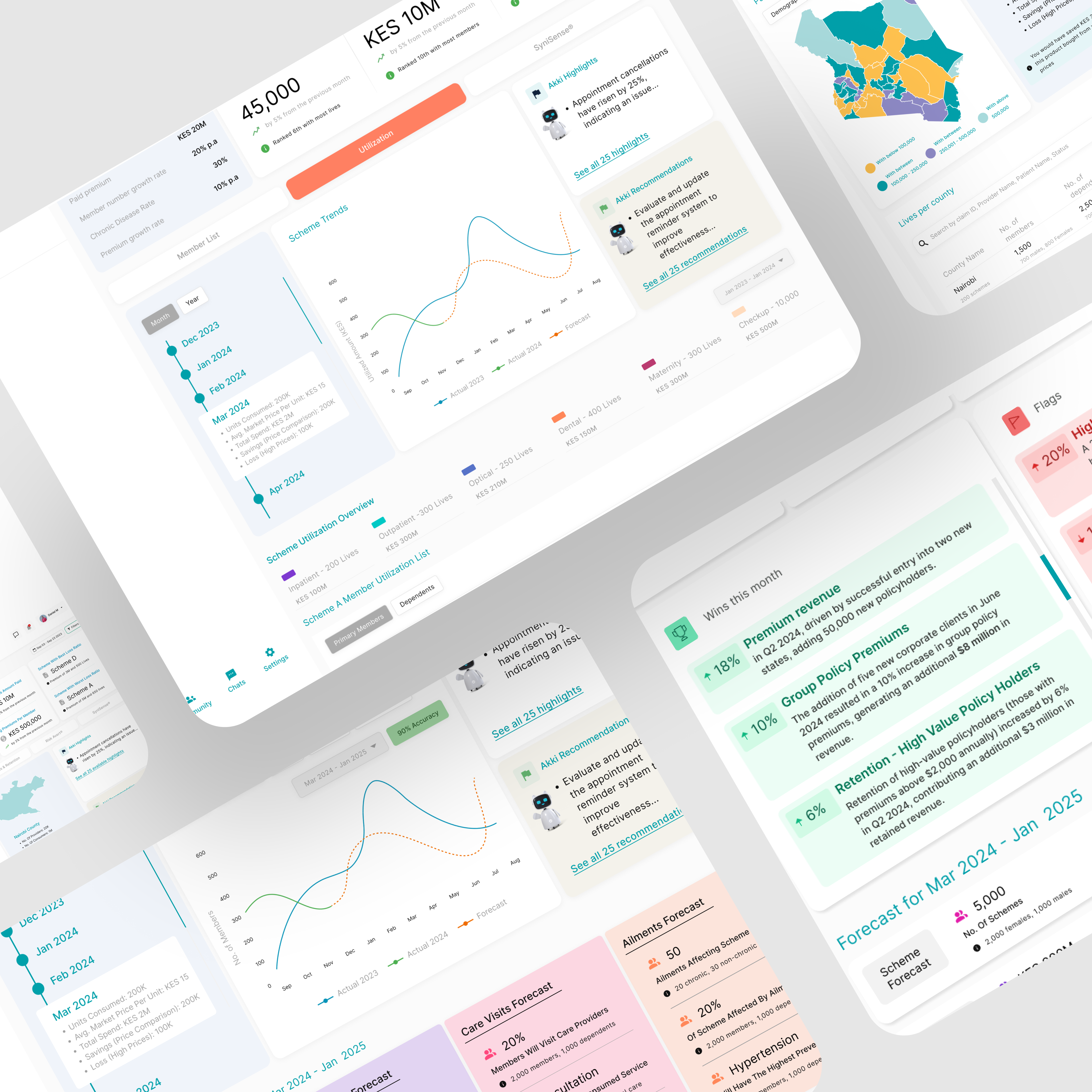
Syni.ai — Enterprise AI Platforms
Leading product design across an AI product development studio — designing enterprise decision intelligence tools and executive AI adoption environments.
2
Designers Managed
2
Platforms
120+
Design System Tokens
3→1
Handoff Rounds
Overview
Syni.ai is an AI product development studio building production-grade tools for complex environments. I lead product design across the company's platforms and programmes, managing a team of 2 designers based in Pakistan.
The work spans enterprise-facing AI platforms, executive capacity building tools, and the company's own web presence.
Note
Syni.ai's product strategy is under NDA. This case study focuses on design process and challenges, not proprietary business logic.
The Problem
The Intelligence Gap
Organizations in complex, regulated industries have more data than ever — spread across warehouses, SaaS platforms, operational databases, and communication tools — but no unified way to make sense of it. Decision-makers wait days for analyst reports when they need answers now.
The Adoption Gap
Even when AI platforms exist, leadership teams don't deploy them. Not because the technology doesn't work — but because they've never used it with their own data in a safe environment. There's no conviction. Enterprise AI stalls at the pilot stage because the people who approve budgets don't trust what they haven't experienced firsthand.
Akki Platform
An AI platform that unifies organizational data into a single, governed, queryable layer.
Data Unification Experience
How enterprise sources connect into a coherent knowledge graph without requiring users to understand the underlying architecture. The complexity is real — the interface isn't.
Contextual Intelligence Interfaces
Turning raw data into insights that are relevant and actionable for the specific person looking at them, not generic dashboards. The right answer for a CFO looks different than the right answer for an operations lead.
Executive Decision Views
Dashboards for strategic planning, operational interfaces for day-to-day management, and predictive models for scenario analysis — each calibrated to the decision being made.
Embedded Governance
Security, compliance, access controls, and data lineage tracking designed into every interaction, not bolted on as a settings page. Governance is a design principle, not a feature.
Akki Sandbox
A controlled, isolated environment where leadership teams validate AI capabilities using their own data before committing to enterprise deployment.
Isolated Instance Experience
Each organization gets a dedicated environment. The UX communicates complete data separation and security at every step — not through warnings and disclaimers, but through the feel of the product.
Onboarding & Data Configuration
How organizations bring their own data in, configure their environment, and start testing. The goal is time-to-first-insight — get leadership to their 'aha' moment before the evaluation window closes.
The Conviction Path
The sequence of experiences designed to move a skeptical executive from 'show me' to 'I've seen it work with our data.' This was the core design challenge — not a UI problem, a trust-building problem.
Security & Deletion Controls
Data ownership, automatic deletion, and compliance made visible and controllable by the user, not hidden in policies. When an executive can see exactly what happens to their data, they engage more deeply.
How I Work on This
Managing a Remote Team
2 designers in Pakistan. I write design briefs that stand alone without a meeting. We work async with structured review cycles — brief, independent work, structured feedback, iteration.
Ecosystem Thinking
Design decisions in the Akki Platform directly inform the Sandbox. The experiences need to feel connected so that an executive who tests in Sandbox has conviction about what they'll get in production. Every decision asks: does this hold across both products?
Designing for Trust
Every AI output needs to be explainable. Every data operation needs to be auditable. Governance isn't a feature — it's a design principle baked into every screen. If a user can't understand why the AI said what it said, the platform fails its purpose.
Design System
Built a unified design system that works across enterprise dashboards and the sandbox testing environment — consistent enough to feel like one product family, flexible enough to serve very different user contexts. Maintained with rigorous async documentation across the team.
What I Learned
- Enterprise AI adoption is a trust problem, not a technology problem. The Sandbox exists because the best AI platform in the world doesn't get deployed if the CEO hasn't touched it with real data.
- Managing a remote design team requires design briefs that are documents, not conversations. If the brief can't stand alone, it's not ready.
- A shared design system across very different product contexts forces you to think in primitives, not patterns. The same token system needs to feel right in a C-suite dashboard and a data configuration wizard.
- Designing for regulated industries means governance is a core UX concern. Data lineage, access controls, and compliance aren't settings pages — they're part of every interaction.
Project Gallery